poniedziałek, 11 listopada 2013

US sends water, generators, and troops to aid deadly typhoon survivors


The U.S. military has dispatched aid and troops to some of the areas of the Philippines that were hardest-hit by a deadly typhoon Friday, providing the first outside help of what is expected to be a major aid mission in the coming days and weeks. 
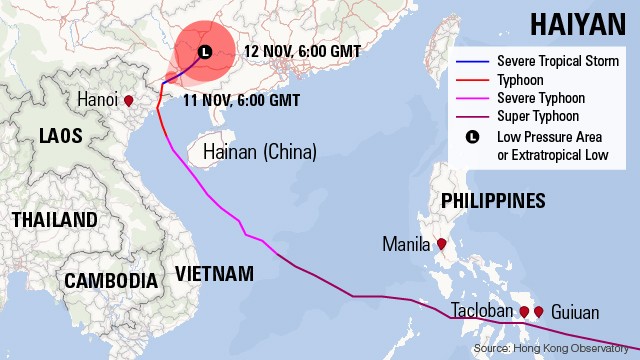
Map: Typhoon's path
Two U.S. C-130 transport planes containing water, generators, and a contingent of Marines flew from Manila's Vilamor air base to the city of Tacloban, where officials fear that Typhoon Haiyan may have killed as many as 10,000 people. 
A U.S. Marine brigadier general who took a helicopter flight over Tacloban says "every single building" was destroyed or severely damaged. Paul Kennedy spoke as supplies were unloaded from the two Marine C-130 planes.
The Philippine military says it has confirmed 942 people have died in the aftermath of the storm, with 275 others confirmed missing. The death toll is expected to rise considerably as officials and aid workers access the worst-hit areas and discover more bodies. 
Disrupted transportation and communications links have made it difficult to count the dead and distribute relief goods. Destruction from the typhoon, which slammed into the central Philippines on Friday, was extensive, with debris blocking roads and trapping decomposing bodies.
Dodaj napisTyphoon aftermath 'apocalyptic'
Meanwhile, the Philippine National Red Cross said Monday its search and rescue efforts are being hampered by looters, including some who attacked trucks of food and other relief supplies the agency was shipping from a port city.
Rescuers also faced blocked roads and damaged airports on Monday as they raced to deliver desperately needed tents, food and medicines to the eastern Philippines.
Police guarded stores to prevent people from hauling off food, water and such non-essentials as TVs and treadmills, but there was often no one to carry away the dead -- not even those seen along the main road from the airport to Tacloban, the worst-hit city along the country's remote eastern seaboard.
Dodaj nVolunteer 'touched by the generosity'
A 19-year-old student in Tacloban says he tried to ride out the storm in his home with his ailing father, but the storm surge carried the building away. Marvin Daga says they clung to each other while the house floated, but it eventually crumbled and they fell into the churning waters. He says his father slipped out of his grasp and sank -- and that he's not expecting to find him alive.
Larry Womack and his wife Bobbie, American missionaries from Tennessee, have lived in Tacloban for a long time. Womack says he chose to stay at their beachside home, only to find the storm surge engulfing it. He survived by climbing onto a beam in the roof that stayed attached to a wall. Womack says, "There were actual waves going over my head."
With other rampant looting being reported, President Benigno Aquino III said Sunday that he was considering declaring a state of emergency or martial law in Tacloban, as officials have proposed. The national disaster agency can recommend such a measure if the local government is unable to carry out its functions, Aquino said.
A state of emergency usually includes curfews, price and food supply controls, military or police checkpoints and increased security patrols.
Aquino flew around Leyte Island by helicopter on Sunday and landed in Tacloban to get a firsthand look at the disaster. He said the government's priority was to restore power and communications in isolated areas and deliver relief and medical assistance to victims.

Aid agencies trying to reach survivors
Authorities said at least 9.7 million people in 41 provinces were affected by the typhoon, which is called Yolanda in the Philippines but is known as Haiyan elsewhere in Asia. It's one of the most powerful recorded typhoons to ever hit land and likely the deadliest natural disaster to beset this poor Southeast Asian nation. At least 23,000 houses had been damaged or destroyed. Ships were tossed inland, cars and trucks swept out to sea and bridges and ports washed away. 
"In some cases the devastation has been total," said Secretary to the Cabinet Rene Almendras.
Regional police chief Elmer Soria said he was briefed by Leyte provincial Gov. Dominic Petilla late Saturday and was told that there may be 10,000 deaths in the province, mostly by drowning and from collapsed buildings. The governor's figure was based on reports from village officials in areas where the storm hit.
A mass burial was planned Sunday in Palo town near Tacloban, which is located about 360 miles southeast of the capital of the Philippines, Manila. It was one of six islands slammed by the storm, which was one of the strongest on record to have hit the Philippines.
"Please tell my family I'm alive," Erika Mae Karakot, a survivor on Leyte island, told an Associated Press reporter as she lined up for aid. "We need water and medicine because a lot of the people we are with are wounded. Some are suffering from diarrhea and dehydration due to shortage of food and water."
Groups mobilize to help typhoon victim
Even though authorities had evacuated some 800,000 people ahead of the typhoon, the death toll was predicted to be high because many evacuation centers -- brick-and-mortar schools, churches and government buildings -- could not withstand the winds and water surges. Officials said people who had huddled in these buildings drowned or were swept away.
Survivors wandered through the remains of their flattened wooden homes, hoping to salvage belongings or find loved ones.
Residents have stripped malls, shops and homes of food, water and consumer goods. Officials said some of the looting smacked of desperation but in other cases items taken included TVs, refrigerators, Christmas trees and a treadmill. An Associated Press reporter in the town said he saw around 400 special forces and soldiers patrolling downtown to guard against further chaos.
"We're afraid that it's going to get dangerous in town because relief goods are trickling in very slow," said American Bobbie Womack. "I know it's a massive, massive undertaking to try to feed a town of over 150,000 people. They need to bring in shiploads of food."
Philippine President Benigno Aquino III said he was considering declaring a state of emergency or martial law in Tacloban. A state of emergency usually includes curfews, price and food supply controls, military or police checkpoints and increased security patrols.
Haiyan hit the eastern seaboard of the Philippines on Friday and quickly barreled across its central islands, packing winds of 147 mph that gusted to 170 mph, and a storm surge of 20 feet.
It inflicted serious damage to at least six islands in the middle of the eastern seaboard, with Leyte, Samar and the northern part of Cebu appearing to bear the brunt of the storm.
Video from Eastern Samar province's Guiuan township -- the first area where the typhoon made landfall -- showed a trail of devastation similar to Tacloban. Many houses were flattened and roads were strewn with debris and uprooted trees. The ABS-CBN video showed several bodies on the street, covered with blankets.
"I have no house, I have no clothes. I don't know how I will restart my life. I am so confused," an unidentified woman said, crying. "I don't know what happened to us. We are appealing for help. Whoever has a good heart, I appeal to you -- please help Guiuan."
The United Nations said it was sending supplies but access to the worst hit areas was a challenge.
"Reaching the worst affected areas is very difficult, with limited access due to the damage caused by the typhoon to infrastructure and communications," said UNICEF Philippines Representative Tomoo Hozumi.
The Philippines, an archipelago nation of more than 7,000 islands, is annually buffeted by tropical storms and typhoons, which are called hurricanes and cyclones elsewhere. The nation is in the northwestern Pacific, right in the path of the world's No. 1 typhoon generator, according to meteorologists. The archipelago's exposed eastern seaboard often bears the brunt.
Even by the standards of the Philippines, however, Haiyan is a catastrophe of epic proportions and has shocked the impoverished and densely populated nation of 96 million people. Its winds were among the strongest ever recorded, and it appears to have killed more people than the previous deadliest Philippine storm, Thelma, in which about 5,100 people died in the central Philippines in 1991.


niedziela, 10 listopada 2013

Typhoon Haiyan: Thousands feared dead in Philippines

Around 10,000 people may have died in just one area of the Philippines hit by Typhoon Haiyan, according to officials.


The storm was so powerful that it washed large ships ashore in the city of Tacloban
Homes were flattened in much of the city
Many people in Tacloban have been made homeless
The scene resembled the aftermath of a tsunami
People have been struggling to find foodSurvivors walk past a ship that lies on top of damaged homes after it was washed ashore in Tacloban city, Leyte province central Philippines on Sunday, Nov. 10, 2013. Photograph: Aaron Favila/AP

An aerial view of damaged houses in Iloilo, Philippines.
An aerial view of damaged houses in Iloilo, Philippines. Photograph: Reuters
Residents cover their nose from the smell of dead bodies in Tacloban city.
Residents cover their nose from the smell of dead bodies in Tacloban city. Photograph: Bullit Marquez/AP
Authorities expect a “very high number of fatalities” after one of the strongest typhoons on record devastated the central Philippines, cutting communications and severely damaging an airport in one of the hardest-hit regions.

A senior regional police official and a city administrator in the typhoon-ravaged city of Tacloban in the central Philippines said early Sunday that the death toll there could reach 10,000 people, according to the Associated Press.

Regional police chief Elmer Soria said he was briefed by Leyte provincial Gov. Dominic Petilla on Saturday and told there were about 10,000 deaths on the island, mostly by drowning and from collapsed buildings.

Tacloban city administrator Tecson Lim said that the death toll in the city alone "could go up to 10,000."

On Samar Island, which is facing Tacloban, Leo Dacaynos of the provincial disaster office said Sunday that 300 people were confirmed dead in Basey town and another 2,000 are missing.

He said that the storm surge caused sea waters to rise 20 feet when Typhoon Haiyan hit Friday, before crossing to Tacloban.

There are still other towns on Samar that have not been reached, Dacaynos said, and appealed for food and water. Power was knocked out and there was no cellphone signal, making communication possible only by radio.

Earlier, the Philippine Red Cross told Reuters that based on reports itestimated at least 1,200 were dead in Tacloban, which is located about 360 miles southeast of Manila, and 200 more in Samar Province.

Interior Secretary Max Roxas arrived in Tacloban Saturday and said it was too early to know exactly how many people had died following Typhoon Haiyan, which was heading toward Vietnam and expected to hit the country’s coast Sunday afternoon.

“The rescue operation is ongoing. We expect a very high number of fatalities as well as injured,” Roxas said. “All systems, all vestiges of modern living – communications, power water, all are down. Media is down, so there is no way to communicate with the people in a mass sort of way.”

Rescue crews reported difficulty in delivering food and water to affected areas due to damaged roads and fallen trees.

U.S. Secretary of State John Kerry said in a statement that America “stands ready to help,” and the president of the European Commission said a team had been sent to “contribute with urgent relief and assistance.”

piątek, 8 listopada 2013

Mega Typhoon Smashes Philippines With Top Winds at 235 MPH


A house is engulfed by the storm surge brought about by powerful typhoon Haiyan that hit Legazpi city, Albay province Friday Nov.8, 2013 about 325 miles south of Manila, Philippines.Nelson Salting/AP Photo


The strongest typhoon this year slammed into the central Philippines on Friday, setting off landslides and 
knocking out power and communication lines in several provinces. At least four people died.

Huge, fast-paced Typhoon Haiyan raced across a string of islands from east to west — Samar, Leyte, Cebu and Panay— and lashed beach communities with over 200 kilometer (125 mile) per hour winds. Nearly 720,000 people were forced to evacuate their homes.

Due to cut-off communications, it was impossible to know the full extent of casualties and damage. At least two people were electrocuted in storm-related accidents, one person was killed by a fallen tree and another was struck by lightning, official reports said.

Southern Leyte Gov. Roger Mercado said the super typhoon triggered landslides that blocked roads, uprooted trees and ripped roofs off houses around his residence.

The dense clouds and heavy rains made the day seem almost as dark as night, he said.

"When you're faced with such a scenario, you can only pray, and pray and pray," Mercado told The Associated Press by telephone, adding that mayors in the province had not called in to report any major damage.

"I hope that means they were spared and not the other way around," he said. "My worst fear is there will be massive loss of lives and property."

Weather officials said Haiyan had sustained winds of 235 kph (147 mph) with gusts of 275 kph (170 mph) when it made landfall. That makes it the strongest typhoon this year, said Aldczar Aurelio of the government's weather bureau.

Eduardo del Rosario, head of the disaster response agency, said a typhoon of similar strength that hit the Philippines in 1990 killed 508 people and left 246 missing, but this time authorities had taken pre-emptive evacuation and other measures to minimize casualties.

The Philippines, which is hit by about 20 typhoons and storms a year, has in recent years become more serious about preparations to reduce deaths. Public service announcements are more frequent as are warnings issued by the president and high-ranking officials, regularly carried on radio and TV and social networking sites.

Provincial governors and mayors have taken a hands-on approach during crises, supervising evacuations, inspecting shelters and efforts to stockpile food and relief supplies.

By 5 p.m. Friday, the typhoon — one of the strongest storms ever — was centered to the west of Aklan province on Panay Island, 320 kilometers (200 miles) south of Manila, after blasting the island resort of Boracay.
typhoon_110713.jpg

Forecasters said it was expected to move out over water south of Mindoro island Friday evening and into the South China Sea on Saturday, heading toward Vietnam.

Among the evacuees were thousands of residents of Bohol who had been camped in tents and other makeshift shelters after a magnitude-7.2 earthquake hit the island province last month.

Jeff Masters, a former hurricane meteorologist who is meteorology director at the private company Weather Underground, said the storm was poised to be the strongest tropical cyclone ever recorded at landfall. He warned of "catastrophic damage."

But he said the Philippines might get a small break because the storm is so fast moving that flooding from heavy rains — usually the cause of most deaths from typhoons in the Philippines — may not be as bad.

środa, 6 listopada 2013

Blasts at China regional Communist Party office kill one


A series of small blasts have killed at least one person outside a provincial office of the ruling Communist 
Party in northern China, state media report.

View gallery."
China blasts


The blasts in Taiyuan in Shanxi province appeared to have been caused by home-made bombs, Xinhua reported.
In this photo released by China’s Xinhua News Agency, smoke billows from after explosions on the Yingze Street in Taiyuan, capital of Shanxi Province.

It said eight people had been injured and two cars damaged.

They do not often make the headlines but explosions in China's cities are not unheard of. Earlier this year, in another part of Shanxi Province, Chinese media reported that a bomb exploded outside the house of a local law official, killing his daughter. The culprit was a pensioner enraged by a court ruling against him.

Last year the BBC reported on a suicide bombing in Shandong, carried out by a disabled man upset by lack of compensation for an industrial accident. Every year there are examples of attacks with crude weapons or explosives, carried out by the desperate, the dispossessed and the disturbed, usually triggered by a dispute with some arm of local government or a local official.

It's too early to say whether the explosions on Wednesday follow the same pattern. But some details will worry the authorities: the ball bearings apparently placed inside the bombs, increasing their destructive power; the fact that witnesses reported several explosions over a period of time. And the bombs were placed outside the local Communist Party headquarters - was the party itself the target, or was this just the 
product of a local dispute?

Blasts at regional China Communist Party OfficePHOTO: About 20 cars parked 100 metres away from the site had been damaged, state media reported. (Weibo: Caixin)
The authorities will especially be nervous after last week's apparent suicide attack outside the gates of the Forbidden City, especially as the capital also prepares to host a meeting of China's Communist Party elite on Saturday.

Tensions are also high in the wake of last week's incident in Beijing. A car ploughed into a crowd in Tiananmen Square in what the authorities said was a terrorist attack incited by extremists from the western region of Xinjiang.

Later this week, the Communist Party's top officials will meet in Beijing to start a major economic planning meeting.'Seven loud blasts'

"Several small explosive devices went off at Taiyuan's Yingze Street near the provincial party office," Shanxi police said in a post on their verified microblog.

"Provincial leaders went to the scene immediately, and police are currently investigating the case," the post added.

"Police officers found steel balls, circuit boards and similar explosive materials at the scene," state-run news agency Xinhua said.

"The initial judgement is that the explosions were man-made."

The explosive devices were hidden in roadside flower beds, according to Chinese state television.

However, two witnesses told Xinhua they saw a minivan exploding, sending car debris flying.

Eyewitnesses also told Xinhua they heard "seven loud blasts", and saw a large amount of smoke at the site.
This image circulating on social media appeared to show ball bearings used in the home-made devices
Car windows were shattered at the site of the blasts
Police cordoned off the street as they investigated the case
Residents gathered in the streets following the explosions

Photos posted on microblog Sina Weibo appeared to show cars windows and tyres that were damaged as a result of the blasts, as well as metal ball bearings.

One of those injured was in a serious condition, state media said.

Taiyuan police said in a verified microblog post that two-way traffic was restored on Yingze Street at 10:30 local time (02:30 GMT).

Taiyuan, the capital of Shanxi, a province in north central China home to large-scale coal mining, is home to more than four million people.'Furious ways'

The blasts quickly became one of the most discussed topics on Chinese microblogs.

On Sina Weibo, one of China's largest microblog providers, the term "Shanxi provincial commission" was the second-most used search term on the site, while "Taiyuan explosion" came sixth.

Many users expressed shock at the use of ball bearings in the bombs. "This is too ruthless," user Lawyer Wang Junsun wrote.

User Hemlocks wrote: "In these days it is the best not to wander about at places with political symbolism. If one has to go, then one should be extra careful."

Several users linked the incident to growing social and economic pressures in the country.

Microblog user Xurizhaohaifeng said: "This proves that high-handed policies do not bring stability, it will only explode in other more furious ways."

User Haoling A wrote: "We are against all acts of terrorism! But we are also opposed to [the government] using the excuse of anti-terrorism to turn China into a country ruled by the police!"

wtorek, 5 listopada 2013


Two billion planets in our galaxy may be suitable for life

Data from Kepler space observatory suggests planets capable of supporting life are far more common than previously thought

One in five sun-like stars may host planets in their habitable zone where liquid water could sustain life. Illustration: Reuters

Our galaxy probably contains at least two billion planets that, like Earth, have liquid water on their surfaces and orbit around their parent stars in the "habitable zone" for life. The nearest, according to astronomers, could be a mere 12 light years away.

A new study, published today in the Proceedings of the National Academy of Sciences, suggests that Earth-like planets capable of supporting life are far more common than previously thought. Using measurements from Nasa's Kepler space observatory, scientists led by Erik Petigura the University of California, Berkely, estimated that 22% of our galaxy's sun-like stars had rocky planets circling them that were within the zone that meant they got roughly the same amount of light energy as Earth gets from the sun. There are around 100bn stars in our galaxy, of which 10% are like the sun.

So far Kepler has studied more than 150,000 stars and identified more than 3,000 candidate planets, but many of these are "gas giants", similar to Jupiter, that orbit close to their parent stars. If there is life out there, it is far more likely to have evolved on rocky planets with liquid water on their surfaces, similar to Earth.

To get their results, Petigura's team looked for planets in Kepler data that had a radius up to double that of Earth. They searched for planets that orbited far enough from their star that liquid water would not evaporate, but not so far that the water would all freeze.

Subhanjoy Mohanty, an astrophysicist at Imperial College London who was not involved with the study, said: "This is the first estimate of the frequency of Earth-like planets around sun-like stars, in orbits large enough to lie in the habitable zone of their stars. The finding that roughly one in five sun-like stars may host such planets is an incredibly important one, probably exceeding the expectations of most cautious astronomers."

He added that the latest analysis increased the chances that there might be life somewhere among the stars. "Previous analyses of Kepler data had shown that red dwarfs – the most common type of star in the galaxy, making up about 80% of the stellar population – very frequently harbour Earth-size planets, including in their habitable zones. This new study shows that the same is true as well around stars more like our own sun. This is certainly an added impetus for planned future missions which will study the atmospheres of these potentially habitable planets, enabling us to investigate whether they are in fact habitable or not, and also whether their atmospheres show actual biosignatures of existing life."

Nasa also announced on Monday that the Kepler probe would be given a new lease of life, following fears that it would have to end its mission after only four years in space. In May 2013, scientists discovered that one of the gyroscopic wheels – known as "reaction wheels" – that kept the probe pointing in the right direction had stopped working and, try as they might, Nasa engineers could not get it working again. Unable to point itself at the stars with any accuracy, the probe could no longer be used to collect data about the position of new exoplanets.

But it looks as though there could be a solution that reorients the probe to look along the plane of the galaxy, which will allow it to remain stable with only two of its reaction wheels working. "The old saying 'necessity is the mother of invention' has rung true here, with engineers and scientists from Nasa and the spacecraft manufacturers having figured out this way to, we hope, recover much of the performance we thought we had lost. We are very excited," said Bill Chaplin, an astrophysicist at the University of Birmingham in the UK.

If all goes well, the new Kepler mission – dubbed "K2" – will look for planets around smaller stars than the sun, and will also study the stars themselves. "There are a wealth of fantastically interesting targets for astrophysics that can be observed in the ecliptic plane, which were not accessible in the original Kepler field, notably brighter clusters of stars – where the common origins and distances to these stars make the clusters excellent laboratories for testing our understanding of stars – and young, star-forming regions," said Chaplin.

poniedziałek, 4 listopada 2013

American flags burned as 10,000 Iranians protest on US Embassy siege anniversary


TEHRAN -- At least 10,000 Iranians protested outside the former U.S. Embassy in Tehran Monday, burning American flags and effigies of Barack Obama on the anniversary of the 1979 seizure of the building.

Annual demonstrations take place at the site, marking the date on which activists stormed the embassy 34 years ago and took 52 staff hostage for 444 days -- an act that severed diplomatic ties with the U.S. for more than three decades.

But this year’s demonstration was larger than usual, fueled by anger among Iranians at President Hassan Rouhani's recent moves to reopen dialogue with the West.

The crowd comprised mainly students and old revolutionaries from 1979, with equal numbers of men and women. It was at least ten times bigger than in previous years.

The air was thick with smoke as countless U.S. and Israeli flags went up in flames, accompanied by chants of "death to America" and the waving of anti-U.S. banners.

Reporters were issued with press credentials marked with the phrase "down with U.S.A.

Several protesters told NBC News they were taking part because they did not trust the U.S. and did not want Iran to do a deal with its arch-enemy.

The sentiment follows Rouhani presenting a far more moderate approach to international relations than his predecessor, the hardliner Mahmoud Ahmadinejad.

Rouhani broke the 34-year diplomatic silence between Iran and the U.S. with a 15-minute telephone call to Obama after the U.N. general assembly in September. It followed an exclusive interview with NBC News’ Ann Curry in which Rouhani said: "We are not seeking ... and looking for war with any nations. We are seeking peace and stability among all the nations in the region.”

The Iranian president also wrote an op-ed in the Washington Post in which he declared an end to "the age of blood feuds," adding: "World leaders are expected to lead in turning threats into opportunities."

This approach has been applauded by many Iranians, but Monday’s protests were not the first occasion Rouhani has been criticized for his perceived warming to the country Iran used to call "the Great Satan."

On his return from the U.N. General Assembly in New York, Rouhani was met with a large crowd of supporters in Tehran. Others, however, booed him and pelted his car with eggs, tomatoes and shoes.

On Sunday, Iran’s most powerful public figure, Supreme Leader Ayatollah Ali Khamenei, gave a speech backing the country’s nuclear negotiators. This was an apparent warning to hardliners not to accuse Rouhani of compromising with its old enemy, Reuters reported.

"No one should consider our negotiators as compromisers," Khamenei said, according to the news agency. "They have a difficult mission and no one must weaken an official who is busy with work."

On Saturday, an editorial by conservative newspaper Kayhan warned against trusting the U.S. in current nuclear negotiations, Reuters said. The editorial said there were signs that "the Americans are aiming to trick the Islamic Republic" in the next round of talks this week.